Gutters in Hobart commonly become blocked by leaves, bark, twigs, moss, mud and other debris washing down from the roof. When this build-up restricts water flow, gutters can overflow and potentially damage the roof edge, fascia, walls and areas around the property.
Because gutters are positioned above eye level, a blockage can remain unnoticed until heavy rain exposes the problem.
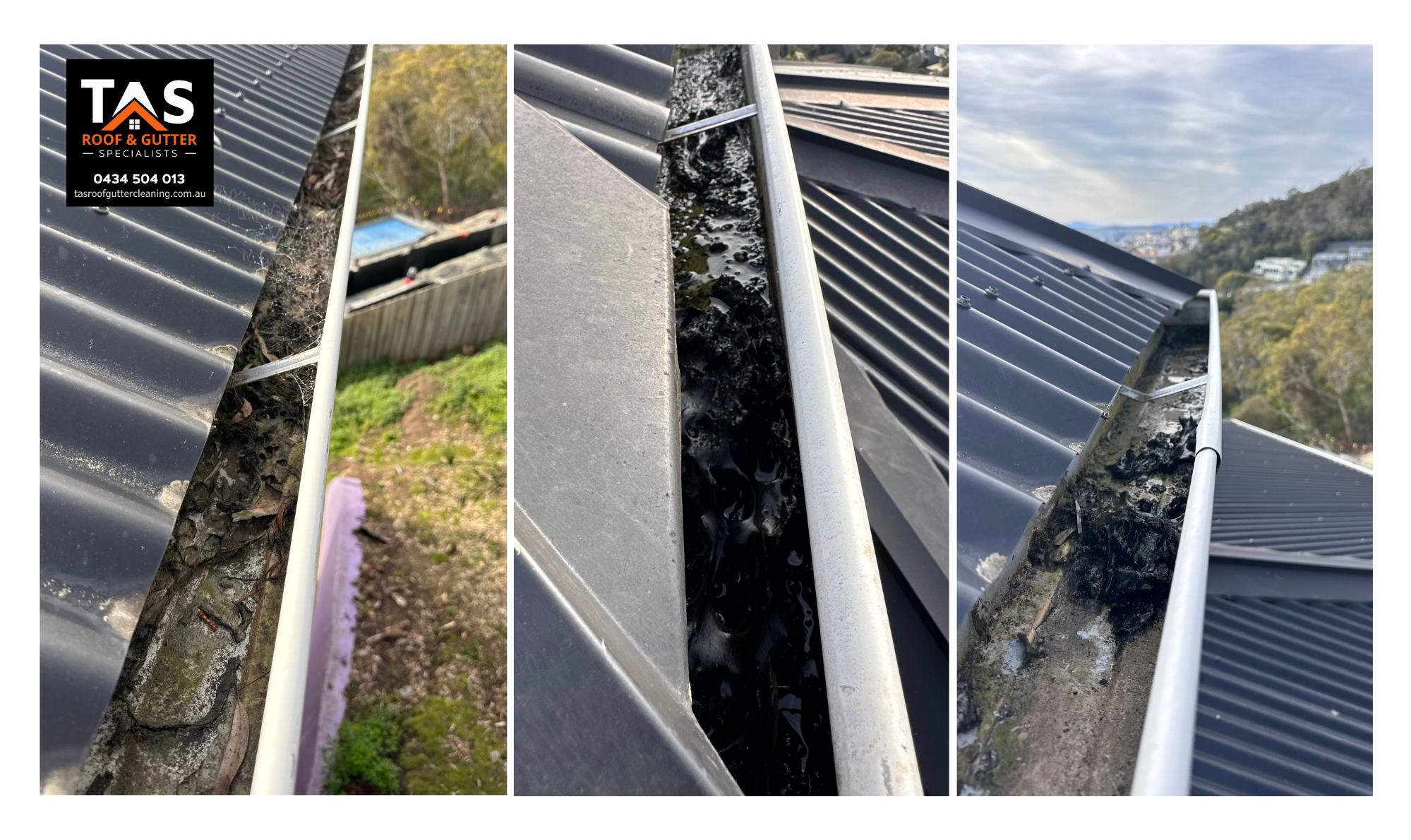
Blocked gutters in Hobart on the metal roof
Why Do Gutters Become Blocked in Hobart?
Most gutter blockages develop gradually rather than happening overnight. Common causes include:
Leaves, Bark and Twigs
Trees do not need to be directly beside the house to affect the gutters. Hobart’s wind can carry leaves, bark and small branches from surrounding vegetation onto the roof.
Rain then washes this debris into the gutters, where it can become wet, compacted and difficult for water to move.
Moss, Dirt and Gutter Sludge
Moss and other organic material can loosen from roof surfaces and collect inside the gutters. When mixed with dirt, decomposing leaves and fine roof particles, it can form thick gutter sludge.
This build-up may not be visible from the ground, but it can restrict drainage and hold moisture against the gutter surface.
Blocked Downpipes
A gutter may look reasonably clear while the downpipe opening is partially or completely blocked.
Leaves and twigs can collect around the opening or move further into the downpipe. During heavy rain, water may quickly back up and overflow because it cannot leave the gutter efficiently.
Gutter Guards and Mesh
Gutter guards can reduce the amount of larger debris entering the gutter, but they do not eliminate the need for maintenance.
Leaves may collect on top of the mesh, while seeds, dirt and small organic particles can build up underneath. In some cases, sections of the gutter guard need to be lifted or removed to clean the gutter properly.
Poor Fall or Sagging Gutters
Gutters need the correct fall to direct water towards the downpipes. If a section has sagged, moved or was installed with insufficient fall, water may remain in low areas.
Standing water allows mud and debris to settle more quickly and may indicate that cleaning alone will not completely resolve the drainage problem.
What Damage Can Blocked Gutters Cause?
A gutter system is designed to move roof water safely away from the building. When that system becomes blocked, water can overflow into areas that are not intended to remain wet.
Possible problems include:
Fascia and eave damage: Repeated overflow can contribute to staining, peeling paint, timber deterioration or corrosion around the roof edge.
Roof and ceiling leaks: Water may move towards vulnerable roof areas and contribute to moisture inside the roof space, stained ceilings or damaged insulation.
External wall damage: Water running down cladding, brickwork or painted surfaces can cause staining, dampness and surface deterioration.
Gutter corrosion: Wet leaves and sludge hold moisture against the gutter, potentially accelerating rust and deterioration.
Sagging gutters: Saturated debris and standing water add considerable weight, placing pressure on brackets, joins and fixings.
Ground and drainage problems: Overflow may erode soil, damage garden beds and create ongoing wet areas close to the building.
Blocked downpipes: Debris can move deeper into the drainage system and cause water to back up around downpipe connections.
Blocked gutters do not always cause immediate visible damage. However, repeated overflow can gradually turn a maintenance problem into a more expensive repair.
What Are the Warning Signs of Blocked Gutters?
You may need to have your gutters checked if you notice:
water spilling over the gutter during rain;
plants growing from the gutter;
visible leaves, twigs or moss;
sagging or misaligned gutter sections;
staining on fascia boards or walls;
damp patches around eaves or ceilings;
water collecting near the building;
slow drainage through downpipes;
rust or leaking gutter joins.
Even one of these signs can indicate that water is not moving through the system correctly.
Can You Clean Blocked Gutters Yourself?
Working from a ladder or near a roof edge carries a serious risk of falls, particularly on multi-storey properties, sloping ground or wet surfaces.
Professional access may be more appropriate if the property has:
two or more storeys;
steep or fragile roofing;
difficult ladder access;
gutter guards that need to be removed;
solar panels or other roof obstructions;
gutters above decks, extensions or sloping ground.
If the gutters cannot be accessed safely, the work should be completed using appropriate equipment and safety procedures.
Choosing Reliable Gutter Cleaning in Hobart
Many homeowners search for the best gutter cleaning Hobart service, but the cheapest advertised price does not always provide the most complete result.
A reliable gutter cleaning provider should clearly explain:
what will be removed;
whether mud and internal build-up are included;
how downpipe areas will be checked;
whether gutter guards affect the work;
how difficult access will be managed;
whether water-flow testing is available;
whether visible gutter problems will be reported;
if before-and-after photos can be provided.
Need Professional Gutter Cleaning in Hobart?
TAS Roof & Gutter Cleaning provides professional gutter cleaning for residential, commercial and strata properties across Greater Hobart.
We assess your property and recommend the most suitable service based on its roof, gutters, access, debris level and visible condition.
No guesswork—request a detailed gutter cleaning quote within 24 hours.
-
Yes. When water cannot drain correctly, it may overflow or move towards vulnerable roof-edge areas. However, roof leaks can have several causes, so the source should be properly assessed.
-
No. They can reduce larger debris, but fine dirt, seeds and organic material can still accumulate underneath. Leaves can also block the surface of the mesh.
-
A partial blockage, restricted downpipe, poor gutter fall or limited drainage capacity may not be noticeable during light rain. Heavier rain places more pressure on the system and can expose the problem.
-
Not always. Mud, moss and decomposed organic material may remain along the bottom of the gutter, while downpipe openings can still be restricted.
-
Hobart’s wind and surrounding vegetation can carry leaves, bark, twigs and seeds onto roofs—even when large trees are not directly beside the property. Rain then washes this debris into the gutters, where it can mix with moss and dirt to form compacted build-up.
-
There is no single best month for every property. It is sensible to check gutters after heavy leaf fall or strong winds and before wetter periods. Homes surrounded by mature trees may need more frequent gutter cleaning than properties in open areas.
-
Yes. TAS Roof & Gutter Cleaning services residential, commercial and strata properties across Hobart and surrounding areas, including gutter service in Glenorchy, residential gutter cleaning and gutter repairs Moonah, Sandy Bay, Taroona, gutter service at Kingston area, Margate and nearby locations.